Psychology in Perception

Psychology plays such a big role in the way we perceive the things that are communicated to us. We all have a little bit of confirmation bias which means we tend to look for evidence that confirms our ideas while avoiding or ignoring evidence to the contrary. This confirmation bias plays a big role in the way we perceive mass news stories. In today’s political climate people tend to either be conservative or liberal in their political beliefs. So when a news story is presented people will hear and retain the parts in the story that pertain to their beliefs rather than the parts that don’t. Our beliefs are so anchored to our identity that we will perceive an unbiased news story differently than someone with opposite views from us.

Another factor for the way we perceive things is dependent on our past experiences and the assumptions we make based on those experiences. I have experienced assumptions in my lifetime based on my outside appearance. I have a tracheotomy in my neck that I hook up a ventilator to at night that breathes for me. This is a very unusual reason to have a tracheotomy so because of this doctors in particular perceive me as someone who is unable to talk. People form mental groupings of similar objects, people, ideas, and events and because of this doctors usually make the assumption that I can’t talk based on the way they have grouped things from their past experiences.

Our moods can also affect the way we perceive stuff in media. If someone was watching tv who was hungry and a commercial came on for Dominoes Pizza they are more likely to order Dominoes Pizza than someone who wasn’t hungry at all. It can be compared to shopping when hungry. If you shop while hungry you are more likely to buy food you don’t need rather than if you shopped while not hungry.

So many different psychological factors can play a role in how we perceive things that are communicated to use through different media outlets. It seems like media sources are very aware of these psychological factors and use it to their advantage whether it be for advertising or news stories. I believe it’s best to be aware ourselves of the way confirmation bias, assumptions, and our moods can affect the way we perceive things so that we can stay open minded and maybe perceive things differently from our initial reaction.
Think Before You Speak

What comes to your mind when you hear the word retarded? Do you think of it describing someone with a mental disability or as a way to insult someone? I would argue a lot of people think of it as just a way to insult someone because of the way society has evolved that word into an insult. The definition of the word retarded is “less advanced mental, physical, or social development than is usual for one’s age.” Urban dictionary defines it as “A word used to describe someone who is profoundly stupid. A type of stupidity that is an insult to intelligence itself.”

The word retarded was created in the late 1800’s as a medical term to describe someone with a mental disability but when society got a hold of it they turned it into an insult without realizing the consequences it could have. While I was in elementary school every kid in my class used it including myself. Someone would trip and then we would say “Oh man you’re soooo retarded”. As kids we didn’t think twice about saying it or what it really meant. As I got older I started to understand more what the word actually meant because I spent a lot of time in the hospital. When I started realizing the origin of the word and what it was meant for I wanted to be more careful with the way I used it. I thought to myself “oh I’ll only say this around a select few people so I don’t accidentally insult someone who actually has a mental disability.” It seemed like a good solution to me but what I didn’t realize was breaking this habit of saying it would be hard. I eventually slipped and said it at the worst place possible. I volunteered at a special needs camp and said retarded to 2 fellow counselors. Thankfully no campers were around but it was at that time I realized I couldn’t just say it to select people and it be okay to use that word. Imagine the affect it could’ve had on one of the kids who had a mental disability if they heard me use that word in those terms.

Society has taken this word that was intended as a medical purpose and turned it into such a derogatory word. So much so that President Obama passed a law called Rosa’s Law to have the word taken off federal records and replaced with the words “intellectual disability”. Some people might think now that it’s no longer used in the medical world to describe it’s okay to use it as an insult but because of the origin of the word retarded I still believe it’s not okay. Given it’s such a recent change it could still be offensive to one with a mental disability. I don’t believe people use this word intending to be disrespectful to people with mental disabilities. I believe people use it due to lack of knowledge as to where the word came from and what it actually meant. But as adults lack of knowledge is not a good enough excuse. As adults we need to educate ourselves better because words really can hurt even if that’s not what we intended.

The Stress of Writing

Writing… It’s not something that comes easy to me. Even as I sit here writing something that should be easier because it’s about myself I have to think hard and long about what I want to say before I can even write down a sentence. The sentence before this I retyped about 5 times because it didn’t feel quite right to me. I’m a perfectionist and I don’t feel like I’m perfect when I write.

Most likely it’s due to the lack of experience and confidence with writing. I spent my kindergarten through 8th grade years at a Montessori school that was amazing with academics but never really got into aspects of learning how to write academically. We learned how to structure sentences and would do some creative writing type stuff such as writing poems but that’s about it. Then for high school I did this different home schooling program where I would teach myself off of learning packets that were provided. I graduated high school when I was 16 and all the work I did I never once had to provide an essay for school. Not writing in high school never seemed like a big issue to me. I was 16 so all I cared about was hurrying up and getting out of school. It never occurred to me at that age that I would need to write for college.

Fast forward to 7 years later and I’m thinking I want to finally go to college and have to take the ACCUPLACER test and write an essay for it. When I go to take it I sit there in front of the screen for what felt like forever just trying to form some sort of start to the essay. Luckily the topic was “Is happiness a choice?” so I had some opinion on the topic but even then I had to B.S. my way through most of the essay. I’m extremely hard on myself so I just kept saying this thing sucks but whatever I don’t know what else to do. In retrospect it probably wasn’t as bad as I thought.

Because of this inexperience sitting down to write especially if it’s an assignment creates a lot of stress and anxiety for me. Judging is the nature of our society but I don’t like the thought that someone is going to read my writing and judge me because I didn’t structure a sentence or place a comma right (or at all).

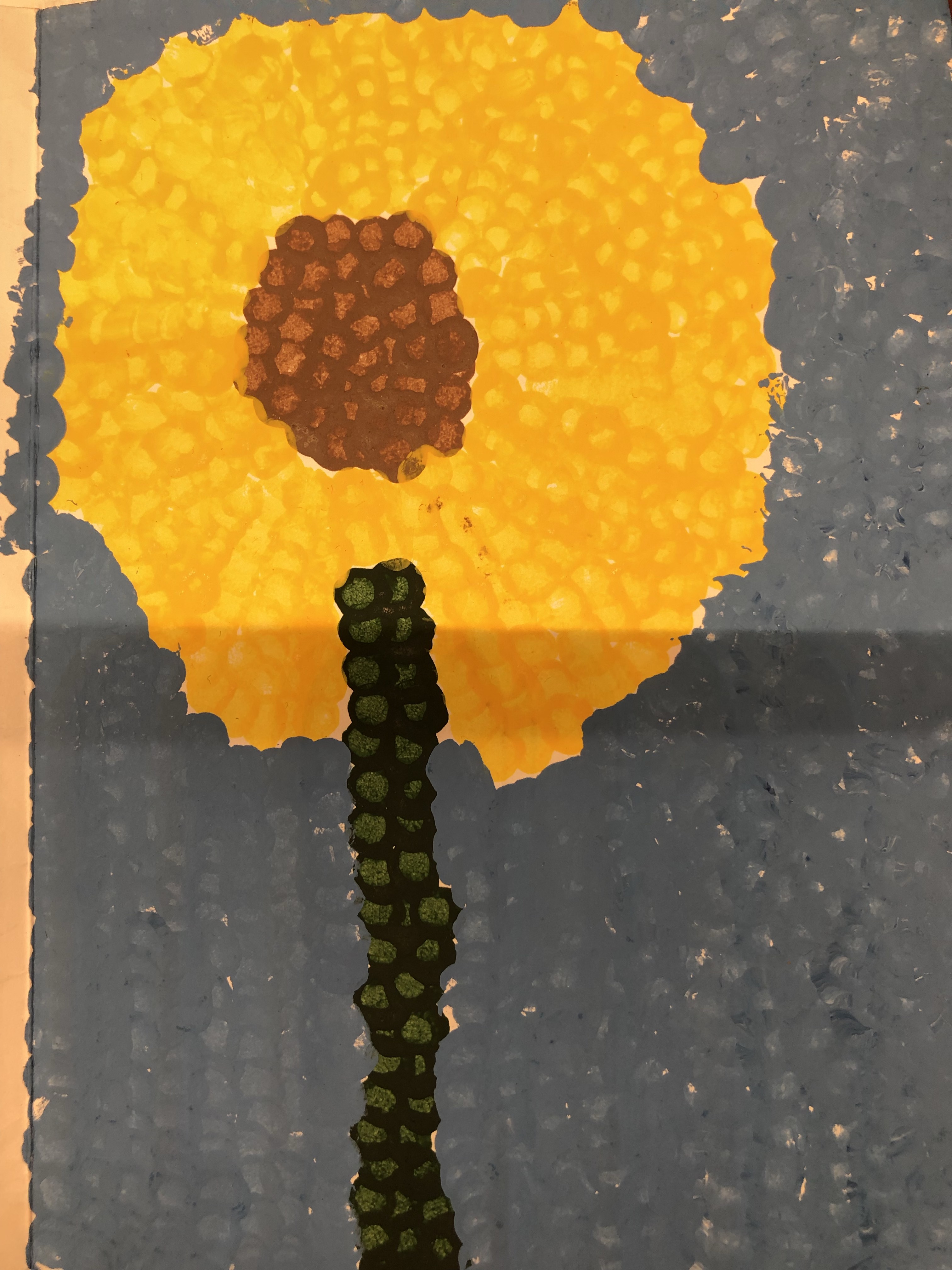
Something that has recently given me a hint of confidence is a poem I wrote when I was 10 or 11 for my mom as a mothers day present. It also has a sunflower I painted for her next to it. The poem is titled My Mother and reads:

My mother smells like,   Hair spray freshly sprayed      Beautiful perfume sprayed on her skin                           Freshly applied makeup                                                   The strong scent of fruity lotion

My Mother sounds like,                                                     Laughing when we play together,                                   Snoring when she is asleep,                                             A sigh when I massage her,                                             A click when she bites her nails                                      A scream when I startle her

My mother feels like, Slippery oil on her skin,                                                     Fake nails scratching my back,                                       Smooth skin as she leans against me,                            Warmth as she hugs me

This poem is extra special to me because she passed away this last August suddenly. As I was sorting through her stuff I found this poem that I had written for her for 13 years ago. She moved a ton and lost almost everything she had but knowing she carried this with her all those years gives me more confidence in my writing abilities.

Writing is not something that I always enjoy. I’d way rather sit down and have a conversation with someone to convey my thoughts and ideas to them instead of writing it in a paper. But I know it’s necessary for so many different things in life so I’m hoping to get more comfortable with it over time. Each assignment I do I find myself easing up and relaxing a bit more.

Reproduction is art

In this modern day reproduction is everywhere you look. Whether it be paintings made into magnets, or celebrities faces on a t-shirt you’re wearing. It’s everywhere.

In chapter one of “Ways of Seeing” the author, John Berger, discusses the potential harms of replication. He describes how seeing a replication before seeing the original work can take away from the artist and their intentions behind it. Even showing the art work and having someone else’s description next to it can take away from it and what your initial thought would be if you saw the piece without any sort of description.

While I do agree there can be some potential harms with replication, especially in this day and age with social media where someone can replicate your whole social media page, I believe overall replicating art is a good thing. To me reproduction is a form of art. If you think about it everything is reproduced in some way or another. When you look at a landscape photograph that is a reproduction of the land. A portrait painting of someone is a reproduction of the person through the painters eyes. Even an abstract painting is a reproduction of what’s originally in the painters head. Describing the art piece with words could even be considered a reproduction of it. Now you might say that reproducing something like classic art is different but it’s not. When people reproduce classic art they put their ever so slight artistic influence over it however they reproduce it. Whether it be on a magnet, a shirt, or a smaller painting of the original painting. I’d like to think classical painters would look at these reproductions as a compliment. After all, imitation is the greatest form of flattery there is.

Another way reproduction is a good thing is accessibility. Accessibility is a big deal to me considering that I grew up with disabilities that made it hard for me to leave the house sometimes. There are a lot of individuals with disabilities that leave them bedridden who enjoy art but can’t travel to see the actual artworks. Without reproducing art there’s a whole audience that might never be able to experience it otherwise. That also applies to reproducing artwork by describing it with words. While I do believe Berger has a point in saying that when you add a description next to an artwork it can take away from your initial thoughts on the piece of art, without it the blind community would have no way to experience it. Some people rely on those words as their only form exposure to the artwork.

There are pros and cons to reproducing artwork as there are pros and cons to everything in this world, but I believe the pros outweigh the cons in this case.

They Say, I Say Part 1

Chapter 1 “They Say”

In this chapter Gerald Graff and Cathy Birkenstein talk about the art of writing using the technique of “They say”. The authors do this by first telling a story about how they attended a talk where the speaker talked about a Dr called Dr. X. The speaker goes on and on about how great Dr X’s work is but fails to give a point as to why he needs to make this talk. It’s clear to them that the Dr’s work is good but what made him need to give the talk in the first place? Did someone disagree with Dr X? By not telling his listeners what other people are saying about Dr X he fails to enter into a conversation and engage his listeners. As a writer you want to make what you’re writing about clear as early as possible to keep readers engaged. If you wait too long readers tend to wonder what your point is and lose interest. The advice Graff and Birkenstein offer to make your point and to keep readers engaged is to treat writing as though you’re entering into a conversation. You can do this by starting with “what others are saying” and then respond with what your own ideas are. Telling readers what “They say” can give them a better understanding of what you’re writing about. As you move through your text it’s a good idea to keep reminding readers of what “They Say”. A good way to do this is to use what Graff and Birkenstein call “return sentences” throughout your text. Using return sentences helps show the importance of what you’re writing about throughout your piece.

Chapter 2 “Her Point Is”

For this section Graff and Birkenstein talk about the best ways to summarize. To write a good summary it’s all about balancing. Balancing what the original author has to say along with what stuck out to you as the writer. When writing a summary you want to be able to put yourself in the shoes of the original writer. If you’re able to adapt the beliefs of the writer you’re summarizing for a moment you can produce unbiased articles. At the same time as doing that you want to remember what your view is. If you forget to include your influence in your summary you can fall victim to creating list summaries. Another thing to keep in mind for good summaries is using signal verbs. If you use boring phrases such as “she says” or “they believe” it can be draining to the idea you are summarizing. Instead of using things like “he says” you can try to use more passionate signal verbs like “he states” or “he comments”. Graff and Birkenstein give us some good examples of passionate verbs such as assert, praise, reaffirm, and question.

Chapter 3 “As He Himself Puts It”

Chapter 3 is all about how to use quotations properly and efficiently. Selecting a quote can be tricky. You want to make sure the quotation you select supports the narrative of your text. As your text evolves you may go back and find that the quotation you originally picked doesn’t fit with your narrative anymore. There’s a lot of back and forth for selecting quotes when you start revising what you are writing. A main issue that writers have when quoting is assuming a quote can speak for itself. Just because a quote is obvious for you as the writer doesn’t mean it will always be for the reader. Graff and Birkenstein tell us here “In a way, quotations are orphans: words that have been taken from their original contexts and that need to be integrated into their new textual surroundings.” Here the authors are telling us that when we take quotes and put them into our text they need to be adequately framed by giving them an intro and an explanation after the quote. Sometimes writers can worry about over explaining a quote. Not all quotes require the same amount of explanation. If you are not sure if you should further explain a quotation it’s best to just go for it so you don’t leave your quotes stranded and your readers wondering.

Something that really helped me in this chapter is learning that writing is like having a conversation. I think the biggest challenge for me though in writing is figuring out how to translate that conversation into a writing piece that flows and makes sense. And also figuring out how to write quicker and more efficiently.